Florist Window · Ongoing guidance
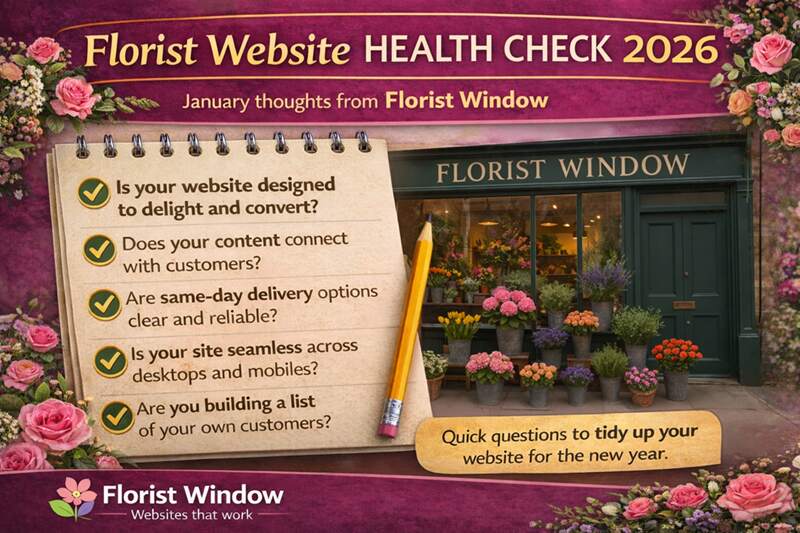
Florist Website Health Check for 2026
January thoughts from Tim at Florist Window
January is always a good time to pause, take stock, and gently tidy things up.
This isn’t a sales post. It’s simply a collection of thoughts, questions, and observations I’ve picked up from working closely with independent florists every day. Some will be relevant to you, some won’t. Take what’s useful, ignore the rest.
I’ll be sharing more so this first post is intentionally light. Think of it as the start of a wider 2026 health check.
A few simple questions to ask yourself
There’s no right or wrong here. These are just worth revisiting from time to time.
Memberships don’t automatically generate sales, but they do help with credibility, trust, and positioning. If you already hold them, make sure they’re visible. If you don’t, it may be worth reviewing whether they still align with where your business is today.
Strengthening your product offering online
One thing many florists overlook is how much range depth matters online.
For example, Oasis offer a dedicated funeral product image range. It’s well photographed, professionally styled, and designed specifically to support florists selling funeral work online.
Adding more high-quality products to your website can help you:
- Appear for more searches on Google
- Give customers more choice
- Generate repeat value from a one-off investment
The cost is currently around £59–£69 as a single payment, ordered directly from Oasis. If you choose to purchase it, they provide a download link. Send that link to us and that’s our green light to add the range to your Florist Window site for you.
There’s no obligation. It’s simply another tool available to you.
If I were running a florist shop today
I’d photograph everything.
Not staged shoots once a year. Real designs, leaving the workspace, ready for delivery. Multiple angles. Consistency.
A simple tripod, a neutral background, and a small lighting setup can go a long way. You don’t need perfection. You need clarity and honesty. Customers respond well to that.
I often say this half-jokingly, but there’s truth in it. With the right setup, you’re halfway to becoming the David Bailey of your own flowers.
A simple margin check worth doing
Once or twice a year, I would take a quiet hour to review a selection of recent website orders and look closely at what actually reaches the business account.
Some website providers publish that they apply percentages or service fees to direct florist sales. Others operate on a flat monthly basis. Neither approach is hidden, but the impact on margins is often only noticed when you stop and look.
Understanding whether any deductions apply to product value, delivery charges, or transactions as a whole helps you make informed pricing decisions and keeps your business predictable and transparent.
If anything feels unclear, it is worth asking questions and reviewing whether your current setup still aligns with how you want to trade.
Pricing consistency matters more than clever pricing
One of the biggest turn-offs for customers is confusion.
Personally, I’d round prices to the pound. Clean, simple, transparent. No penny-pinching psychology.
Looking at Florist Window data from the last 30 days, the average order value across all clients is £58.01. That tells us something important.
If customers are already comfortable spending around that figure, opening prices around £45 make sense. It sets expectations clearly and allows for natural upsell options like:
- Small £45
- Medium £50
- Large £55 or £60
What I would avoid entirely is showing a thumbnail price that turns out not to match the product shown. If a customer clicks expecting £45 and discovers the image represents a higher price, many will simply leave. That feels like wasted time to them, and time is something shoppers value highly.
Tone, trust, and what not to say
I’d never describe myself as Number One, Leading, Premier, or Best.
It’s self-gratifying, weak persuasion, and can quietly put customers off. Let your work, reviews, and clarity do the talking instead.
I’d also review colours carefully. Anything harsh or glaring gets toned down. Calm, balanced colour palettes keep people browsing longer.
Phone numbers, addresses, and visibility
Check every phone number on your website:
- Does it dial correctly
- Is it click-to-call on smartphones
- Is it easy to find
Publishing a real, full address alongside a local-rate landline number still matters. You can now divert a local number to a mobile for roughly £120 per year, no contract. Many florists now use two numbers, especially in larger towns and cities, both ringing the same phone.
Older customers often prefer landlines. Younger customers are fine with mobiles. Christmas sales data still shows desktop purchases remain strong, particularly during the day.
This isn’t about looking big. It’s about looking established and trustworthy.
One thing I’d remove entirely
“Sold Out”.
I didn’t originally build this feature and I’m increasingly convinced it does more harm than good. Scrolling through dozens of unavailable products turns gift buying into hard work.
Customers want to find something they like first, then order it. Making them filter availability before attraction kills momentum.
It’s the same frustration as clothes shopping by size. You find something great, then discover it’s unavailable. Enough of that experience and people simply leave.
Navigation still matters
I’d keep the Contact link visible and prominent. Always.
Make sure your phone number and location pin are clear on both desktop and smartphone layouts. If someone wants to call you, don’t make them hunt.
Finally, for 2026, I’d go to the homepage and methodically check every single link. Broken links help no one. If you spot one, tell us. Dead links aren’t good links.
More to come
This is only the first part of a wider 2026 health check. I’ll be sharing more thoughts over the next couple of months, covering content, SEO visibility, product structure, and customer behaviour.
As always, take what’s useful. Leave what isn’t. And if you’ve been with Florist Window for years, you already know this comes from belief and genuine care for your business.
More soon.
Tim