Florist Window · Ongoing guidance
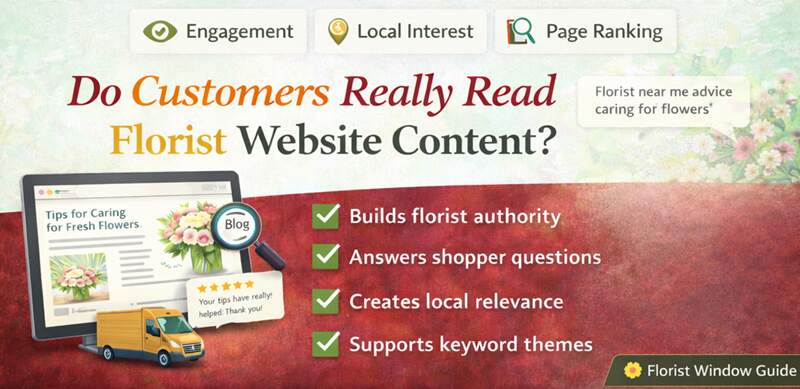
Do Customers Really Read Florist Website Content?
Thoughts from Tim at Florist Window
This is something I hear quite often when discussing florist websites.
“Customers don’t read the text on websites anyway.”
It’s an understandable belief. Many customers browse quickly, especially when they already know what they want to buy.
But the reality is a little more interesting.
Some customers read very carefully. Others simply scan the page. And search engines read everything.
That combination means website content still plays an important role.
At a glance
Many customers scan florist websites rather than reading every word, but clear written content still matters. It helps search engines understand the website and helps customers feel confident in their purchase.
Customers often scan rather than read
Most people browsing the internet move quite quickly.
They are usually looking for visual clues first.
For a florist website that often means:
- photographs of arrangements
- clear pricing
- delivery information
- location details
Customers may only read small parts of the text, but those parts still help guide their decision.
That is one of the reasons florists should still think carefully about selling flowers online. A website is not just there to exist. It is there to help customers understand what you offer and feel comfortable enough to buy.
Words help customers feel confident
Even if customers do not read every sentence, the presence of clear information builds trust.
Simple details can make a difference:
- description of the flowers used
- size of the arrangement
- delivery areas
- care instructions
These details reassure customers that they understand what they are ordering.
Good florist websites do not need to be wordy. They simply need to answer the quiet questions customers are already asking in their own minds.
Search engines read everything
While customers may skim, search engines analyse every part of the page.
Text helps Google understand what the page represents.
This includes things like:
- product descriptions
- page headings
- category titles
- location references
Without written information, search engines have far less context.
This is one of the reasons I wrote about Content Is King. Clear information helps both customers and search engines interpret a website correctly.
It also links closely with the wider question of whether a florist website needs SEO, because most SEO begins with clarity rather than tricks.
Balance matters
Of course, that doesn’t mean florist websites need large blocks of text.
Floristry is visual by nature.
Customers want to see the flowers first.
The written content simply supports the images by explaining what the customer is looking at.
That balance is important. Too little information can leave customers uncertain. Too much can feel heavy. The best florist websites usually sit somewhere in the middle — visual first, but supported by clear wording.
Clarity always wins
When florist websites perform well, they usually share one thing in common: clarity.
Clear photographs.
Clear prices.
Clear descriptions.
Customers rarely complain about too much clarity.
In fact, a lot of the time when a florist wonders why the website is not performing as expected, it comes back to the same issue: the customer is not being shown enough useful information quickly enough. I touched on that in Why Your Florist Website Might Not Be Number One on Google, because Google and customers both respond better when a site makes sense immediately.
Content works together with structure
Text also helps shape the overall structure of a website.
Categories, headings, and descriptions help organise products in a way that makes browsing easier.
This is why sensible structure and product range often work hand in hand.
I discussed that further in my article about how many products a florist website should have, because the organisation of products often matters as much as the designs themselves.
A customer may not read every line, but they do notice when a site feels easy to follow. That sense of ease often comes from the content structure quietly doing its job in the background.
A final thought
Florists communicate beautifully through their designs.
A website simply adds a small amount of explanation around those designs so customers understand what they are seeing.
Even if customers only read part of that information, the presence of clear content helps build confidence.
And when customers feel confident, they are far more likely to place an order.
So no, not every customer reads every word. But enough of them read enough of it for content to matter. And for Google, it matters even more.
More soon.
Tim