Florist Window · Website design trends
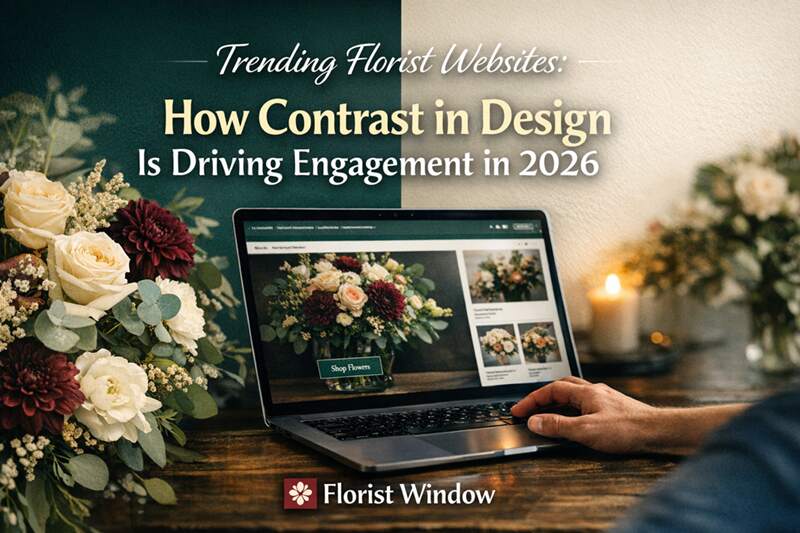
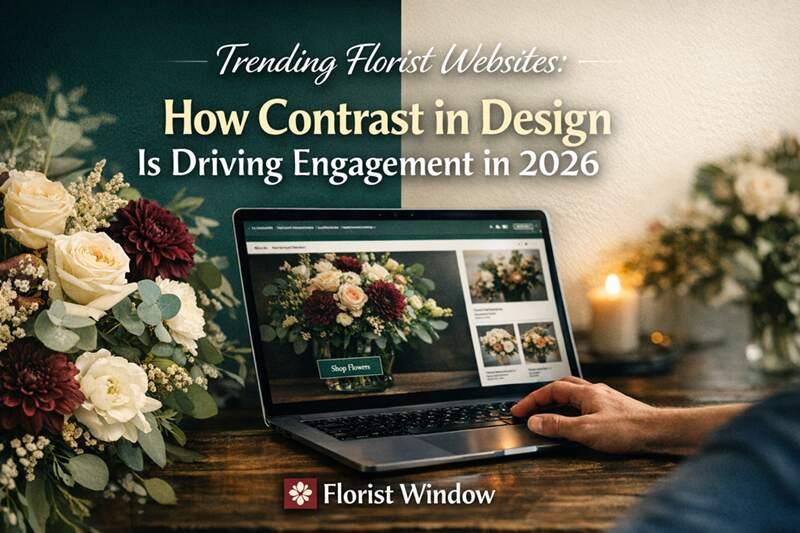
Trending Florist Websites: How Contrast in Design Is Driving Engagement in 2026
Thoughts from Tim at Florist Window
Across florist websites in the UK and Ireland, a clear design pattern is emerging.
Independent florists are moving away from light, generic templates and towards deeper, contrast-led website design, not as a visual trend, but as a deliberate strategy to improve engagement, clarity and brand perception.
Looking at recent florist websites including Hazel Holly, Mayflower Vintage Floral Design and The Floral Decorator, there is a consistent shift in how colour, contrast and layout are being used.
This is not accidental. It reflects a broader change in how florists are using their websites to hold attention, communicate quality and convert directly.
At a glance
Modern florist websites are increasingly using darker, contrast-led design to improve clarity, engagement and brand presentation. Done properly, contrast helps customers focus, browse more easily and buy with confidence.
Contrast is replacing light and pretty
Traditional florist websites often relied on pale backgrounds and soft tones.
What we are now seeing instead is:
- dark green, teal or charcoal base colours
- strong contrast between background and text
- clear visual separation between sections
For example:
- Hazel Holly uses deep teal tones such as #002f31 against white text
- The Floral Decorator combines dark blue-green #1f414b with softer sage accents such as #7e917b
- Mayflower uses a strong green base #3e4f3d paired with gold highlights #D4AF37
This creates a more focused and controlled visual environment.
The flowers remain the focal point, but the website itself now frames them more effectively.
Why contrast works for florists
Floristry is visual. But online, attention is limited.
Contrast helps solve three key problems.
1. It directs attention
Clear contrast between elements tells the customer where to look. Product images stand out more clearly, calls to action are easier to identify, and navigation becomes more obvious.
2. It improves readability
Light text on darker backgrounds improves clarity, particularly on mobile devices.
This reduces friction during browsing and ordering.
3. It creates perceived value
Darker, structured layouts are widely used in luxury retail, editorial websites and high-end ecommerce.
When applied correctly, they give florist websites a more premium and intentional feel.
Contrast and interaction work together
Across all three sites, contrast is not static. It is used in interaction as well.
Common patterns include:
- buttons that invert colour on hover
- text shifting between light and dark backgrounds
- image overlays becoming more visible on interaction
These small transitions, often set at 0.2 to 0.3 seconds, create feedback for the user, add responsiveness, and make the browsing experience feel smoother.
The result is a website that feels active and engaging, rather than flat.
Structured design around organic products
Flowers are naturally soft, detailed and organic.
These websites deliberately balance that softness with strong layout blocks, defined sections and controlled colour palettes.
This matters because, without structure, floral imagery can feel visually overwhelming. With structure, it becomes clearer, more curated and easier to browse.
What this means for florists selling online
At Florist Window, florist websites are built specifically for direct selling.
- No commission
- No relay interference
- Full control over branding, pricing and customers
In this model, the website is not just a brochure. It is the primary sales channel.
Because of that, design decisions matter more. The site must hold attention, guide users clearly to purchase, and reflect the florist’s own identity.
That also raises a common question for florists: do you actually need SEO for your florist website? In reality, much of it comes down to clarity, structure and helping search engines understand what you do.
Contrast-led design supports all three.
A wider shift towards ownership and clarity
There is a broader trend behind this.
Florists are moving away from generic templates, relay-driven visibility and diluted branding, and towards owned websites, direct customer relationships and stronger visual identity.
But ownership alone is not always enough. Many florists still question why their website is not appearing where they expect on Google. This often comes down to how clearly a website communicates its content, structure and local relevance.
Alongside that, taking time to review your website regularly is becoming more important. A simple website health check can highlight small improvements that strengthen both visibility and performance.
It is not just about appearance. It is about control, clarity and confidence in how a florist presents their work online.
Key takeaways
- darker, contrast-led design is becoming more common in modern florist websites
- strong contrast improves usability, readability and engagement
- structured layouts help present floral products more effectively
- hover effects and transitions reinforce user confidence
- design is increasingly tied to direct selling and website ownership
A final thought
The florist websites seeing the strongest engagement are not necessarily the most complex.
They are the ones that use design deliberately.
Contrast, when applied correctly, does one simple thing. It makes it easier for customers to see, understand and buy.
For independent florists selling through their own website, that clarity is what drives long-term results.
More soon.
Tim